Mobility Innovations
Vibracoustic uses AI to develop new vibration dampers
High-Speed Evolution
With artificial intelligence, Vibracoustic engineering teams develop new vibration dampers more precisely and faster.
AI-driven development for maximum efficiency
At Vibracoustic, engineering teams continuously improve their products, extending the use of AI. The technology analyzes hundreds of parameters simultaneously and creates up to 200 possible rubber designs within 24 hours. Only the most promising concepts are pursued further, saving time while increasing precision and efficiency.
 The engineering teams at Vibracoustic use AI to create vibration dampers.
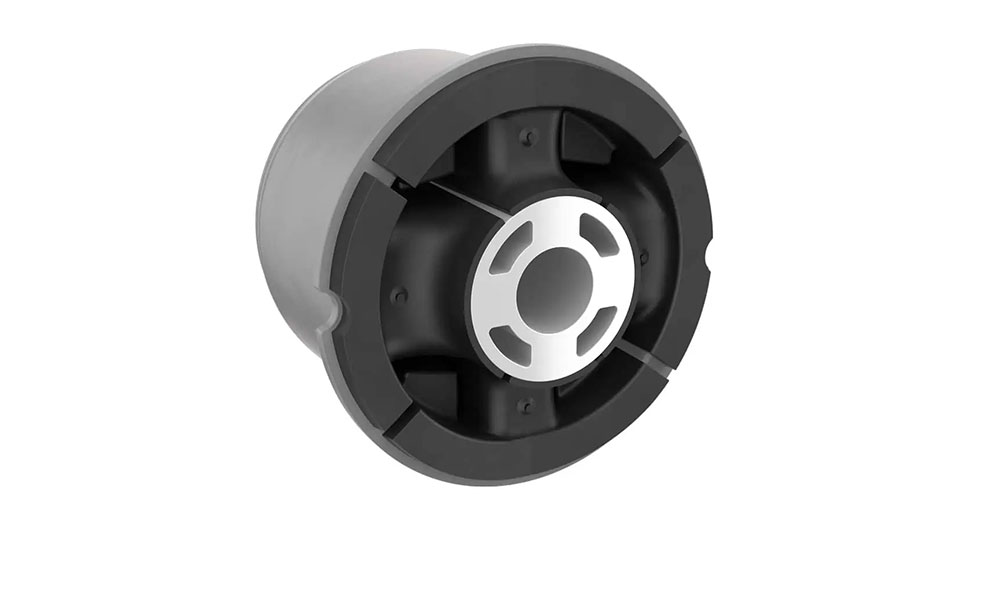 Bushings tackle low to high frequency excitations – either transmitted from the road or engine into the vehicle body.
Speed as a competitive advantage
“Vibracoustic is a global leading manufacturer of NVH (noise, vibration, and harshness) solutions for the automotive industry. We want to accelerate our development times to make sure that we maintain our leading position.” explains Olivier Leclercq, Director Innovation & Digitalization at Vibracoustic. Through AI-supported processes, Vibracoustic wants to respond flexibly to new, powertrain concepts and market demands while setting new benchmarks in NVH development.
Tailored solutions for every vehicle class
Whether it's an electric SUV, a city car, or a hybrid transporter, AI identifies the optimal rubber shape for each application. Practical tests confirm the high degree of consistency between predictions and reality, proving the reliability of the technology and the interaction between humans and machines.
Data-driven into the future
Design automation and AI go hand in hand at Vibracoustic. Automated workflows reduce manual effort, collect data based on the FAIR* principles, and create a foundation for data-driven engineering. With global use, easy accessibility, and continuous extension of design automation, the engineering teams save valuable time and are optimally positioned for the future.
What are the FAIR principles?
The FAIR principles ensure that data is findable, accessible, interoperable, and reusable.
A look ahead
“We are already steadily improving our model with the integration of experimental tests and material data. Our goal is to apply the technology to all the important acoustic rubber metal products.” said Nicolas Le Maoût, FEA (Finite Element Analysis) Engineer at Vibracoustic.
While nature takes millions of years to evolve, Vibracoustic achieves evolution in fast forward – showing how AI is shaping the mobility of tomorrow.